
House of Pokies Casino Australia: How Pokies Work
 Available in US
What are pokies and how they operate in Australian venues
Pokies is the term Australians use for electronic gaming machines, the coin- or note-operated devices found in pubs, clubs and casinos across the country. The word is local shorthand — internationally the same devices are usually called slot machines or poker machines — but in Australian regulatory and industry documents the standard label is electronic gaming machines, commonly abbreviated as EGMs. Both terms describe the same object: a cabinet running randomised reel or video-based games, accepting cash or, increasingly, account-based credit, and paying out according to a fixed return structure programmed into the machine.
Electronic gaming machines are operated in every Australian state, as well as in the Australian Capital Territory and the Northern Territory. This near-universal presence distinguishes Australia from many other gambling markets, where slot machines are confined to licensed casino floors. In Australia, by contrast, pokies are a fixture of suburban and regional life: they sit in local pubs and licensed clubs — RSLs, leagues clubs, sporting clubs — as well as in the dedicated casino venues found in each state capital. This section deals with pokies as a category of machine and as a market; the separate question of how deposits, bonuses and promotional codes are regulated for pokies players is addressed later in this article.
Before picking a casino to play at, it helps to see how welcome offers, licensing and deposit terms stack up across the market so you can judge each site on its actual merits.
License: Curacao OGL/2024/1335/0780 · Bonus: up to A$1,000 + 150 free spins, wager-free · Min. deposit: EUR 20 Holds a Curacao OGL license and offers a wager-free welcome bonus of up to A$1,000 plus 150 free spins, with a EUR 20 minimum deposit.
License: Curacao Gaming Control Board OGL/2023/176/0095 (Hollycorn N.V.) · Bonus: up to A$1,500 + 200 free spins across 3 deposits Licensed under the Curacao Gaming Control Board via Hollycorn N.V., with a welcome package spread across three deposits worth up to A$1,500 plus 200 free spins.
Bonus: 240% up to A$4,100 + 300 free spins Stands out for a large percentage-based welcome bonus of 240% up to A$4,100 alongside 300 free spins.
License: Curacao Gaming Control Board · Bonus: up to A$5,000 + 400 free spins Operates under a Curacao Gaming Control Board license and offers a substantial welcome bonus of up to A$5,000 plus 400 free spins.
License: Curacao · Bonus: up to A$10,000 multi-stage + 500 free spins · Min. deposit: A$20 (POLi) Curacao-licensed with a multi-stage welcome bonus reaching up to A$10,000 plus 500 free spins, and a low A$20 minimum deposit via POLi.
License: Curacao eGaming (Dama N.V.) · Bonus: up to A$10,000 + 180 free spins, 40x wagering Licensed through Curacao eGaming under Dama N.V., offering a welcome bonus of up to A$10,000 plus 180 free spins with 40x wagering requirements.
License: Curacao · Bonus: 100% up to A$500 + 200 free spins, 10x wagering · Payout speed: crypto 30-60 minutes, fiat 1-5 days · Min. deposit: A$10 Curacao-licensed with a 100% bonus up to A$500 plus 200 free spins at a low 10x wagering requirement, backed by fast crypto payouts of 30-60 minutes and a A$10 minimum deposit.
License: Curacao · Bonus: up to A$2,000 Curacao-licensed operator offering a welcome bonus of up to A$2,000.
License: Curacao Gaming Control Board OGL/2023/176/0095 (Hollycorn N.V.) · Bonus: up to A$11,000 + 300 free spins (code NEO100) Licensed by the Curacao Gaming Control Board via Hollycorn N.V., with a sizeable welcome bonus of up to A$11,000 plus 300 free spins available using a bonus code.
License: Tobique Gaming Commission · Bonus: up to A$8,000 + 400 free spins across 4 deposits · Payout speed: crypto ~10-15 minutes, fiat 1-5 days · Min. deposit: A$30 Licensed by the Tobique Gaming Commission, offering a welcome package of up to A$8,000 plus 400 free spins across four deposits, with quick crypto payouts of around 10-15 minutes and a A$30 minimum deposit.
The scale of the pokies market
The volume of money moving through Australian pokies is large enough that it is usually described in terms of national turnover rather than average customer spend. In the financial year 2020–2021, Australians placed bets worth almost AUD 150 billion on electronic gaming machines. Turnover, in this context, refers to the total value of all bets made, not the amount actually lost — because pokies pay out repeatedly during a session, the same money is wagered many times over before a player walks away, so turnover figures are always considerably larger than net loss figures.
The net loss figure for the same period gives a clearer sense of the money actually leaving players’ pockets. In FY 2020–2021, the total player loss from electronic gaming machines across Australia was about AUD 12 billion. Divided across the population, this works out to a per-capita loss of AUD 608 for that financial year — a figure that includes non-gamblers in the calculation and therefore understates what individual pokies players lost, but which is nonetheless used as a standard benchmark for the scale of the activity nationally.
More recent turnover data comes from a single source with a narrower scope. According to figures reported by complyadvantage.com, pokies generated AUD 191.2 billion in gambling turnover in 2023. This number should be read as a report from one source rather than as an official, government-verified statistic on the order of the FY 2020–2021 figures above; it is included here because it is the most recent turnover figure available, not because it has been independently confirmed by a regulator.
Australia’s position in the global pokies landscape is described inconsistently across sources. One figure holds that Australia accounts for 3% of the world’s pub and club poker machines; another puts the figure at around 18% of the world’s poker machines. These two numbers differ by a factor of six, which suggests they are measuring different things — possibly one is restricted to pub and club machines specifically, while the other includes casino floors, or the two draw on different base counts of the global machine population. Neither figure can be reconciled from the sources available, so both are presented here as competing claims rather than as an agreed fact.
Turnover (FY 2020‑2021) AUD 150 billion
Player loss (FY 2020‑2021) AUD 12 billion
AML risk High cash volume and anonymous play increase money‑laundering exposure
How pokies operate across venues
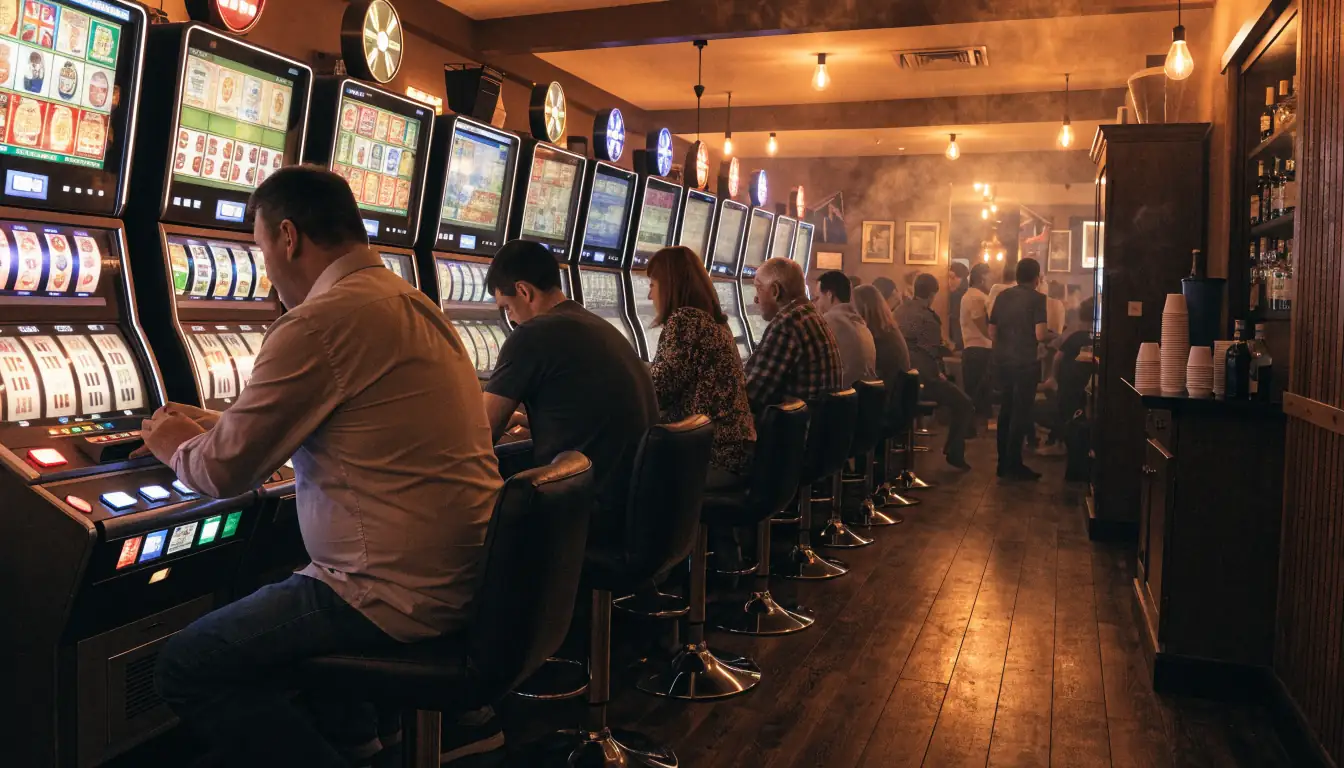
Pokies are found in three broad categories of venue in Australia: pubs, licensed clubs, and casinos. Pubs and clubs typically host machines under state-based gaming licences separate from casino licensing, and the number of machines permitted per venue is generally lower than in a dedicated casino. Casinos, by contrast, operate large gaming floors with substantially higher machine counts, alongside table games and other forms of wagering.
Machine operation itself follows a broadly similar pattern regardless of venue type. A player inserts cash or, on newer machines, loads funds onto an account or card, selects a game and stake, and plays a sequence of rounds determined by a random number generator. Winnings accumulate as in-machine credit, which can be continued into further play, redeemed as a printed ticket, or — on account-based systems — transferred back to the player’s account balance. This basic mechanic, historically built around loose cash and paper tickets, is one of the reasons pokies have drawn sustained regulatory attention in Australia: the same cash-based mechanic that makes the machines simple to use also makes them difficult to monitor.

Taxation and the absence of a national licensing register
Gambling in Australia is regulated at state and territory level rather than nationally, and this is reflected in how pokies operators are taxed. Taxation of gambling operators varies by state and by the type of gambling service offered, meaning a pokies venue in one state may face a different tax structure than an equivalent venue across a border. There is no single national schedule of pokies taxation that applies uniformly across the country.
For players, the position is more straightforward: gamblers’ winnings in Australia are not taxed. This applies regardless of the venue or the state in which the winnings were generated.
It is worth noting that there is no public national register of licensed pokies venues or operators that a player can consult to verify a specific machine or venue’s standing. Oversight instead runs through state and territory gaming regulators — bodies such as the Office of Liquor and Gaming Regulation and the ACT Gambling and Racing Commission handle licensing and compliance within their respective jurisdictions, with additional oversight, on financial crime matters, from AUSTRAC at the federal level.
Why pokies attract money-laundering risk
The high volume of cash transactions typical of pokies, combined with the limited traceability of cash-based play, has made electronic gaming machines a recognised avenue for money laundering in Australia. This is not a marginal or theoretical concern — it is the subject of dedicated regulatory guidance, most notably a guide issued by AUSTRAC in 2024 to help venues and compliance staff recognise money-laundering red flags in pokies transactions.
Money‑laundering risk
Pokies’ large cash transactions and anonymous tickets make them a prime target for laundering, exposing venues to significant regulatory penalties.
Several laundering methods associated with pokies have been documented by regulators and researchers:
- Cash-in, minimal play, cash-out. Criminals insert large sums of cash into a machine, engage in only minimal gambling activity, and then cash out, creating a paper trail that makes the funds appear to be legitimate gambling winnings rather than the proceeds of crime.
- Ticket purchasing. Offenders buy winning tickets from other players, paying cash for a ticket that already represents “clean” winnings — a way of converting illicit cash into funds that appear to have a legitimate gambling origin.
- Structuring across venues. Rather than depositing a large sum at a single venue, launderers spread smaller cash amounts across multiple venues, deliberately staying under the thresholds that would trigger mandatory reporting.
- Use of money mules. According to complyadvantage.com, individuals are recruited specifically to launder money through pokies on behalf of others, acting as intermediaries between illicit cash and the gaming floor.
AUSTRAC’s guidance sets out a series of red-flag indicators that venues and compliance officers are advised to watch for. These include unusually high cash access by a customer, unusually large deposits, cash transfers between individuals on the gaming floor, requests for casino disbursement checks, and patterns of behaviour associated with particular occupations that carry higher money-laundering risk. Beyond these general indicators, several more specific behavioural patterns are flagged:
- Large or repeated cash insertions into a machine followed by minimal play and an immediate cash-out.
- Frequent small redemptions carried out across different venues within a short period of time.
- Customers who refuse to provide identification, or who use multiple player loyalty cards, rather than a single identifiable account.
None of these indicators is proof of laundering on its own — they are described by regulators as patterns that warrant closer scrutiny, not as automatic evidence of wrongdoing.
Compliance obligations on operators
AUSTRAC’s regulatory framework scales obligations according to the size of a venue’s pokies operation. Operators running up to 15 machines face a baseline set of requirements: they must register with AUSTRAC, keep identification records for relevant transactions, and submit suspicious matter reports when red-flag behaviour is identified.
Operators running more than 15 machines face a substantially heavier compliance load. They are required to appoint a dedicated compliance officer, conduct formal risk assessments of their operations, implement a full anti-money-laundering and countering-the-financing-of-terrorism (AML/CFT) program, carry out customer due diligence on players engaging in higher-risk transactions, and report any cash transaction exceeding AUD 10,000 to AUSTRAC.
Failure to meet these obligations carries a range of consequences. Non-compliant operators may receive remedial directions requiring them to fix specific deficiencies, infringement notices, civil fines, and — separate from any formal penalty — reputational damage arising from public association with money-laundering failures.
Operators with more than 15 machines must implement a full AML/CFT program, appoint a compliance officer, and report cash transactions over AUD 10,000 to AUSTRAC.
State-level enforcement can go further still. An amendment to the Casino Control Act 1992 allows New South Wales casino operators to be fined up to AUD 100 million for compliance failures, a figure that reflects the scale of the casino sector’s turnover and the seriousness with which the state treats breaches of its gaming and AML obligations.
The push toward cashless pokies
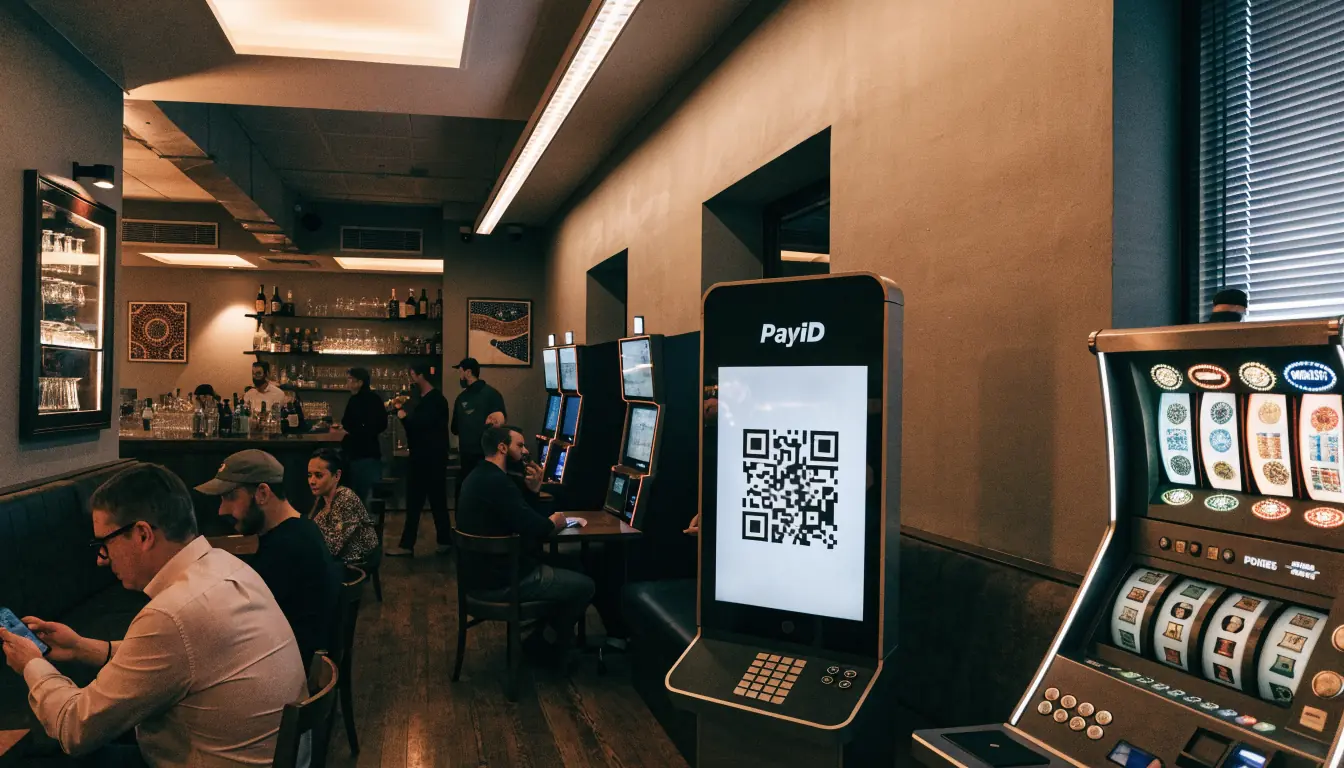
The cash-heavy nature of pokies is widely identified, by regulators and industry researchers alike, as the central reason the machines are vulnerable to laundering: cash is difficult to trace back to its source, and paper tickets can change hands anonymously. The proposed remedy discussed across regulatory and industry commentary is a shift toward cashless, account-based gaming.
The 2022 NSW Islington Report is the most concrete expression of this direction. According to that report, all NSW pokies should be made cashless by the end of 2028 — a recommendation aimed specifically at closing the gap that cash transactions currently leave in the transaction record. It should be noted that this is a single report’s recommendation rather than a law already in force; whether and how it is implemented by that date is a separate question from the fact that it has been proposed.

Industry sources addressing this shift, including facctum.com, describe cashless and account-based systems as improving traceability and reducing the anonymity that cash play currently provides. The underlying logic is straightforward: on a transparent, account-based pokies system, deposits, gameplay and withdrawals are all tied to an identified account, giving venues and regulators a complete transaction record rather than the fragmented picture produced by cash tickets and anonymous play. Providers such as FacctView, FacctShield and FacctGuard are among those offering monitoring and due-diligence tools built around this account-based model, positioning transaction monitoring software as a complement to the regulatory push toward cashless machines.
Regulators’ broader recommendations align with this direction: tighter customer due diligence at the point of large transactions, ongoing transaction monitoring rather than one-off checks, and the progressive adoption of cashless gaming systems across venues, are the three measures most consistently cited as the practical response to the laundering risks described above.
Where pokies sit in the broader Australian gambling landscape
It is worth being precise about what pokies are and are not, particularly given how the term is sometimes used loosely online. Pokies, as described throughout this section, are physical electronic gaming machines located in licensed Australian pubs, clubs and casinos — venues operating under state and territory gaming licences. This is a distinct category from online casino games such as internet slots, roulette or blackjack.
Illegal online pokies
Offering real‑money online pokies to Australian residents breaches the Interactive Gambling Act 2001 and can result in prosecution.
Under the Interactive Gambling Act 2001, it is an offence for online operators to offer real-money online casino games — including slot-style games — to people located in Australia. There is no domestic licence that permits an operator to run an online casino for Australian residents, and none of the state and territory regulators referenced above issue one. This prohibition targets operators, not players individually, but it means that any online platform offering "pokies" for real money to an Australian audience is doing so outside the country’s legal framework, regardless of how the site presents itself. Physical pokies in licensed venues are a separate, lawful activity operating under an entirely different regulatory structure to anything offered online.
This distinction matters for understanding the rest of this article’s subject matter. Everything described above — turnover, per-capita losses, AML obligations, the shift to cashless systems — concerns the regulated, land-based pokies sector: machines standing on the floor of a pub, club or casino, subject to state licensing and federal financial-crime oversight. The scale of that sector, running into tens of billions of dollars in annual turnover and billions in player losses, is what makes pokies one of the most closely studied forms of gambling activity in Australia, and why regulatory bodies from AUSTRAC down to individual state gaming authorities continue to refine how the machines are licensed, taxed and monitored.
Deposit methods, bonuses and code restrictions for Australian pokies players
Searches for no-deposit bonus codes, free-chip offers and sign-up promotions at named online pokies brands are common, but the legal position in Australia makes such offers impossible to fulfil lawfully. The Interactive Gambling Act 2001 makes it an offence for an online operator to provide real-money gambling — including pokies, roulette or any casino-style game — to a person located in Australia. This prohibition applies to the operator, not to the promotional mechanism it uses. A bonus code, a free-chip offer or a no-deposit signup credit does not change the underlying service: it is still real-money online casino gambling being offered to an Australian resident, and offering it remains an offence regardless of how the promotion is packaged or advertised.
No domestically licensed real-money online casino exists for Australian players, and no local licence of that kind can be issued. Any site advertising an Australia-facing no-deposit bonus code for pokies is therefore not operating under Australian authorisation, and no register exists on this market against which such a claim could be checked. Bonus terms, wagering conditions, deposit limits and code validity for these offers are not matters that can be verified through an Australian regulator, because the activity they relate to falls outside what Australian law permits online operators to provide here.

Two points from the surrounding regulatory framework are settled and worth separating from the bonus question itself. Winnings from gambling are not taxed for the player in Australia — this applies to lawful forms of wagering such as sports and race betting, not to unlicensed online casino activity. Separately, taxation of gambling operators is a matter for state and territory governments and varies by jurisdiction and by type of gambling service; this is an operator-side tax question, unrelated to promotional codes or deposit bonuses offered to players.
No deposit method, bonus structure, wagering requirement or code condition for online pokies promotions can be confirmed here, because the offers in question sit outside the activity Australian law allows online operators to conduct with residents of this market.
Written by the editors at Pokies Pro.