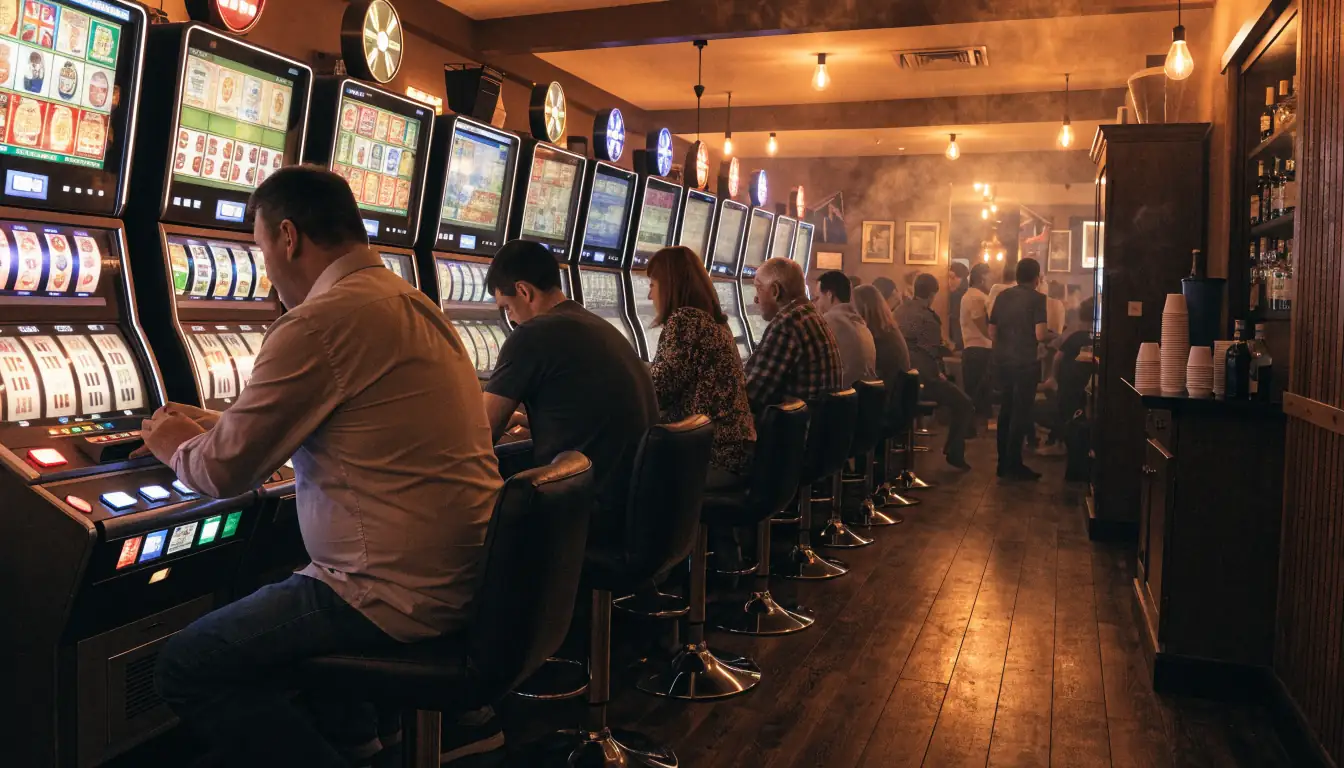
Best Video Slots in Australia: RTP and Volatility Explained
 Available in US
Table of Contents
- Understanding Video Slots in Australia: Definitions, RTP, and Volatility
- Online Casino Regulations and Availability of Video Slots in Australia
- Playing Video Slots for Real Money: What Players Should Know
- Free Video Slot Games: How They Work and What They Offer
- Bonus Rounds in Video Slots: Mechanics and Effect on Returns
Understanding Video Slots in Australia: Definitions, RTP, and Volatility
Video slots are digital slot machine games built around five or more reels, multiple paylines or cluster-pay mechanics, and a random number generator (RNG) that determines each outcome. Unlike mechanical three-reel machines, video slots typically layer in bonus features, wild symbols, and secondary win mechanics, but the mathematics underneath them rests on the same set of variables used across the wider slot machine category: return to player, house-edge percentage, and volatility. Understanding these three terms is a prerequisite for reading any slot’s published specifications, whether the game is accessed through a land-based venue or an online platform.
Return to Player (RTP)
Return to player, commonly abbreviated RTP, is the percentage of wagered money a slot machine returns to players over time. It is calculated using probability-weighted outcomes across every possible result the game’s RNG can produce, rather than being derived from any single session or player. A slot with an RTP of 96% is built to return about $96 for every $100 wagered, calculated across the game’s full mathematical model rather than any individual outcome.
Video slots are only as good as the casino running them, so it pays to check licensing, welcome offers, and deposit terms before you dive into the reels in 2026.
License: Curacao OGL/2024/1335/0780 · Bonus: up to A$1,000 + 150 free spins, wager-free · Min. deposit: EUR 20 Licensed under Curacao OGL, Vegaz Casino stands out with a wager-free welcome package of up to A$1,000 plus 150 free spins, and a modest EUR 20 minimum deposit makes it easy to get started.
License: Curacao Gaming Control Board OGL/2023/176/0095 (Hollycorn N.V.) · Bonus: up to A$1,500 + 200 free spins across 3 deposits Operating under a Curacao Gaming Control Board license via Hollycorn N.V., LuckyVibe spreads its welcome offer of up to A$1,500 plus 200 free spins across three deposits, rewarding players who stick around for a few rounds.
Bonus: 240% up to A$4,100 + 300 free spins WinShark leads with a striking 240% match bonus worth up to A$4,100 alongside 300 free spins, making its welcome offer one of the more generous on paper.
License: Curacao Gaming Control Board · Bonus: up to A$5,000 + 400 free spins Licensed by the Curacao Gaming Control Board, JustCasino backs its slot library with a sizeable welcome bonus of up to A$5,000 plus 400 free spins.
License: Curacao · Bonus: up to A$10,000 multi-stage + 500 free spins · Min. deposit: A$20 (POLi) Lucky Dreams, licensed in Curacao, offers a multi-stage bonus reaching up to A$10,000 plus 500 free spins, and a low A$20 minimum deposit via POLi keeps entry accessible.
License: Curacao eGaming (Dama N.V.) · Bonus: up to A$10,000 + 180 free spins, 40x wagering Licensed through Curacao eGaming under Dama N.V., JeetCity Casino pairs a bonus of up to A$10,000 plus 180 free spins with clearly stated 40x wagering requirements.
License: Curacao · Bonus: 100% up to A$500 + 200 free spins, 10x wagering · Payout speed: crypto 30-60 minutes, fiat 1-5 days · Min. deposit: A$10 Wild Tokyo, licensed in Curacao, combines a 100% bonus up to A$500 with 200 free spins and a fair 10x wagering condition, plus fast crypto payouts within 30-60 minutes and fiat withdrawals in 1-5 days, all accessible from a A$10 minimum deposit.
License: Curacao · Bonus: up to A$2,000 Golden Pokies, operating under a Curacao license, offers a straightforward welcome bonus of up to A$2,000 for players getting started with slots.
License: Curacao Gaming Control Board OGL/2023/176/0095 (Hollycorn N.V.) · Bonus: up to A$11,000 + 300 free spins (code NEO100) Neospin, licensed by the Curacao Gaming Control Board through Hollycorn N.V., features one of the larger bonuses on this list at up to A$11,000 plus 300 free spins, unlockable with the code NEO100.
License: Tobique Gaming Commission · Bonus: up to A$8,000 + 400 free spins across 4 deposits · Payout speed: crypto ~10-15 minutes, fiat 1-5 days · Min. deposit: A$30 Licensed by the Tobique Gaming Commission, SkyCrown spreads a bonus of up to A$8,000 plus 400 free spins over four deposits, and offers quick crypto payouts of around 10-15 minutes alongside fiat withdrawals in 1-5 days, with a A$30 minimum deposit.
RTP is not observed directly by playing a handful of spins. It is established beforehand, through simulation. Developers and testing laboratories run computer simulations of millions or billions of spins to arrive at the published figure. This is why RTP is described as a theoretical value: the theoretical RTP is the built-in percentage encoded into the game’s math model, while the experienced RTP is what an individual player sees over a limited session, which can differ substantially from the theoretical figure simply due to sample size.
A simple illustration makes the distinction between theory and short-term experience concrete. If a slot machine takes $110,000 in total bets across a given period and pays back $100,000 in winnings during that same period, its observed RTP for that period is 90.9%. That figure is a session or period-based measurement, not necessarily the same as the machine’s certified theoretical RTP, which is fixed at a different value and would only be approached as the number of spins grows very large. This gap between short-run results and the long-run theoretical average is the primary reason RTP should not be read as a promise about any particular session.
The industry benchmark for RTP sits around 96%; figures above that threshold are generally considered high RTP, and figures below it are considered low RTP. Progressive jackpot slots are a notable exception to this benchmark: they often carry lower RTP than standard video slots because a portion of every wager is diverted to fund the growing jackpot pool rather than being returned through regular payouts.

House Edge
RTP and house-edge percentage are inverse values. Where RTP describes the share of wagers returned to players, the house-edge percentage describes the share retained by the operator over the same theoretical distribution of outcomes. A slot with a higher RTP therefore carries a correspondingly lower house-edge percentage, and the two figures always sum to the same total. Reading a game’s specification sheet for either value is sufficient to derive the other, since neither number stands independently of the other.
RNG and Independence of Spins
Every spin on a video slot is independent. The RNG ensures outcomes are random and not influenced by previous spins, meaning a machine has no memory of prior results and no mechanism for compensating a losing streak with an imminent win, or vice versa. RTP figures describe the distribution of outcomes across the full set of possible spins the RNG can generate, not a sequence or pattern within any given run. This independence is also what allows theoretical RTP to be calculated through simulation in the first place: because each spin draws from the same fixed probability model, running that model billions of times produces a stable average that would not be achievable if outcomes were path-dependent.
The RTP figure is a theoretical long‑run average; it does not guarantee that any single session will return that percentage.
Volatility
Volatility describes win patterns, frequency and size of payouts, and it operates as a separate axis from RTP rather than a restatement of it. Two slots can share an identical RTP figure while producing very different playing experiences: a low-volatility game tends to distribute smaller wins more frequently, while a high-volatility game pays out less often but with larger amounts when it does. Volatility is typically described using bands such as low, medium, medium-high, high, and very high, and this classification is published alongside RTP in most certified game specifications.
Because volatility governs the shape of the payout distribution rather than its average, it has a direct bearing on how experienced RTP diverges from theoretical RTP over a limited session. A high-volatility title with a strong theoretical RTP can still produce a losing session more easily than a low-volatility title with the same theoretical figure, simply because its wins are concentrated into fewer, larger events rather than spread evenly across spins.
Certification and Verification
RTP figures published for a slot are not simply developer claims. Regulatory certification requires third-party RTP verification, meaning independent testing laboratories examine the game’s underlying math model and RNG before the published RTP can be presented as certified. This verification process is what separates a certified RTP figure from an unverified marketing statement, and it is standard practice among established testing bodies operating across regulated markets.
One detail that complicates comparison across operators concerns configuration. According to bgaming.com, the same slot can have different RTP versions at different operators, since some game engines are built with configurable RTP that allows an operator to select from a range of certified return settings for a single title. This means that the RTP quoted for a given slot name is not always universal; the specific version deployed by a given platform is the figure that applies, and it may not match a figure seen quoted elsewhere for the same game title.
Illustrative High-RTP Titles
Published specifications from individual game providers give a sense of how RTP and volatility are documented in practice. The following figures come from provider-published data for specific titles and describe those particular games as configured by their developer; they are not representative of the video slot category as a whole.
| Title | RTP | Volatility |
|---|---|---|
| Cat’s Soup | 98.06% | Medium |
| Golden Paw: Hold & Win | 97% | Medium |
| Aztec Clusters | 97% | Very high |
| Merge Up™ 2 | 97% | Very high |
| Always Up! x10000 | 96.05% | Very high |
| Blazing Fire Pots Hold & Spin | 96.27% | Medium-high |
These figures show that a high RTP does not correspond to a single volatility profile. Cat’s Soup and Golden Paw: Hold & Win pair strong RTP figures with medium volatility, suggesting comparatively steadier payout distributions, while Aztec Clusters and Merge Up™ 2 pair similarly high RTP with very high volatility, indicating payouts concentrated into less frequent, larger events. Blazing Fire Pots Hold & Spin and Always Up! x10000 sit between these two patterns in terms of volatility classification while maintaining RTP figures above the general industry benchmark. None of these figures should be read as fixed for every deployment of the title, given that configurable RTP settings mean the same game name can carry a different certified percentage depending on where it is offered.
Online Versus Land-Based RTP
A further distinction worth noting at this stage concerns the venue in which a slot is played. Online slots have higher RTP than land-based slots as a general pattern in the data. Crown Perth, as a land-based reference point, sets a minimum RTP of 90% across its slot machines, a figure notably lower than the high-90s percentages seen among the online titles listed above. This gap reflects differences in operating costs and regulatory minimums between physical and digital gaming environments rather than any difference in how RTP itself is calculated or verified; the underlying method, probability-weighted simulation checked by third-party certification, applies equally to both.
Online video slots typically show higher RTP percentages than land‑based machines, reflecting lower operating costs and different regulatory minimums.
Reading RTP and Volatility Together
Taken together, RTP, house-edge percentage, and volatility form the basic technical vocabulary needed to interpret any video slot’s specification sheet. RTP and house-edge percentage describe the long-run average outcome built into the game, volatility describes the shape and rhythm of payouts along the way, and third-party certification is what confirms these figures reflect the actual math model rather than an unverified claim. None of these figures describes what a given session will produce. A high RTP figure reflects a theoretical construct derived from an enormous number of simulated spins, and short sessions can and do diverge from it substantially, in either direction, without indicating any fault in the certification or the RNG itself.
Online Casino Regulations and Availability of Video Slots in Australia
The regulatory position of video slots in Australia differs sharply from the technical picture painted by RTP figures and volatility ratings. A slot can be certified, audited, and mathematically transparent, and still fall outside what any Australian-licensed operator is permitted to offer. The governing statute is the Interactive Gambling Act 2001 (IGA), a Commonwealth law introduced primarily to protect the public through harm minimisation rather than to regulate game fairness. Some sources cite an Interactive Gambling Act 1997 as the instrument prohibiting online casino games for Australian residents; where this discrepancy appears in the record, it is worth noting that the 2001 Act is the version most consistently identified as the operative Commonwealth framework, and the two references likely describe the same legislative lineage rather than two separate regimes.
What the Interactive Gambling Act actually restricts
The IGA does not regulate video slots as a category of game mechanics. It regulates who may lawfully offer them to people in Australia. Under the Act, online casino-style games — including slots, poker, blackjack, and roulette — are prohibited when provided by an operator to Australian residents. This is a supply-side restriction: it is directed at the business offering the game, not at the mechanics of the game itself. RTP, volatility, and bonus structures, the subjects of the preceding section, exist independently of this legal boundary. A slot’s certified return-to-player percentage says nothing about whether the site hosting it is doing so lawfully in this market.
This distinction matters because the two questions — "does this game return money fairly over time" and "may this site legally offer the game here" — are answered by entirely different bodies. RTP is verified by testing labs and made available, in Australia, as part of game information intended to protect players by disclosure. Legality under the IGA is a matter of Commonwealth law enforcement, not laboratory certification. A slot with a transparently high RTP can still be offered by an operator with no lawful basis to serve Australian customers.
No domestic licence covers online casino slots
There is no licensing pathway in Australia that authorises an operator to run online casino games — video slots among them — for local residents. This is unlike sports betting, where state and territory licensing regimes issue authorisations to operators taking bets on racing and sporting events, or lotteries, which are licensed separately. Online casino gambling occupies a different category altogether: it is not merely restricted or heavily conditioned, it is prohibited outright at the Commonwealth level, and no application process exists to change that for a given operator.
The practical consequence is that any website offering video slots to Australian visitors is doing so from offshore, under a licence issued by a foreign regulator, not an Australian one. Common licensing bodies referenced internationally include the Malta Gaming Authority and the UK Gambling Commission, but a licence from either does not constitute Australian authorisation — it is simply the jurisdiction under which that operator was permitted to set up its business elsewhere. Because there is no Australian register of licensed online casino operators, there is also nothing to check a site against locally. Advice to "verify the operator’s licence" only means something where a relevant domestic authority maintains such a register; in this market, no such register exists for online casino products.
The player’s position versus the operator’s position
The IGA is explicit in its target: it is not illegal for an individual in Australia to play at an offshore-licensed online casino. The prohibition falls on the entity offering the service, not on the person using it. This asymmetry is a common source of confusion, since many players assume that a prohibited product automatically makes their own participation unlawful. That is not how the Act is structured. Enforcement action under the IGA is directed at operators — and, relatedly, at Australian entities that might advertise or facilitate access to such services — rather than at the individuals placing bets.
Offshore operators may hold licences from foreign regulators, but those licences do not constitute legal authorisation to serve Australian players.
This has a further consequence for how offshore video slot sites can be found and promoted. Restrictions under the broader Australian regulatory framework prohibit advertising online casino services on social media or other online platforms, and prohibit targeting gambling advertising at minors across any medium, including television and stadiums. A site cannot lawfully be marketed to Australian residents through the channels most commonly used to advertise other consumer products. Anyone encountering promotional material for online casino slots in Australia through mainstream advertising channels is looking at something that should not, by the rules governing this market, be there in that form.
Where video slots sit relative to other regulated products
The regulatory map for gambling in Australia treats different products very differently, and video slots fall on the more restricted side of that map.
| Product category | Legal status in Australia | Licensing basis |
|---|---|---|
| Online sports betting | Legal | State/territory licences |
| Lotteries | Legal | Licensed |
| Online casino games (slots, poker, blackjack, roulette) | Prohibited federally | No domestic licence available |
| Online in-play (live) betting | Prohibited federally | Not licensed for this format |
Sports betting and lotteries are the two categories where Australian licensing genuinely exists and can be checked. Online casino products — video slots included — and in-play betting sit in the prohibited column at the federal level regardless of how the game itself is built or certified. This table reflects legal status, not product quality or fairness; a video slot’s RTP certification, discussed in the preceding section, operates on a completely separate axis from this legal classification.
Certification and disclosure exist, but do not confer local legality
Australian practice around game information does lean toward disclosure: RTP values are often included with game information as a protective measure for players, reflecting a broader regulatory instinct toward transparency rather than concealment. This disclosure norm exists in tension with the underlying prohibition — the same market that expects RTP figures to be visible to players is a market where the games carrying those figures cannot be lawfully offered by a domestically licensed operator in the first place. Certification bodies and testing labs verify that a slot behaves as its published RTP describes; they do not, and cannot, grant an operator standing to serve Australian customers under Australian law. Fairness testing and legal authorisation are answered by different institutions and do not substitute for one another.
This is worth stating plainly because it is easy to conflate the two. A prominently displayed RTP percentage, a recognisable testing-lab logo, or a governing licence from an overseas authority can all be genuine and verifiable, while the underlying activity — offering online casino video slots to someone in Australia — remains outside what Commonwealth law permits any operator to do domestically. None of these signals substitute for an Australian licence, because no such licence exists to substitute for.
What this means for availability
Video slots remain accessible to Australian residents in practice, through offshore-licensed platforms, because the law does not criminalise individual play. But "accessible" is not the same as "locally regulated." No Commonwealth or state authority issues licences for online casino slot products, no public register of approved operators exists to consult, and no advertising of such services through ordinary online or social channels is permitted under the broader gambling-advertising restrictions that apply across this market. The technical qualities of a given slot — its certified RTP, its volatility profile, the mechanics of its bonus rounds — are determined and disclosed independently of this legal status, and neither confirms nor changes it. Readers evaluating any video slot offering in Australia are, in effect, evaluating two separate things at once: whether the game is mathematically what it claims to be, and under what jurisdiction — never an Australian one — the site offering it is actually licensed.
Playing Video Slots for Real Money: What Players Should Know
Wagering real money on video slots differs from casual play in one respect above all: the outcome carries a financial consequence, and that consequence is shaped by mechanics the player cannot alter mid-session. RTP, volatility and bonus structures each work on the return in a different way, and understanding the distinction matters more once actual funds are at stake.
RTP describes the share of wagered money a machine returns to players over time. A slot built with a 96% RTP is designed to pay back about $96 for every $100 wagered — but this figure is a long-run average, not a per-session promise. A single sitting of any length can land well above or well below that theoretical figure. Realised RTP is calculated after the fact from actual bets and payouts: a machine that took $110,000 in total wagers and paid out $100,000 in winnings would show a realised RTP of 90.9% for that period, regardless of what its built-in theoretical figure says. A high theoretical RTP is a statement about the machine’s design over a large number of spins, not a guarantee that a short paid session will land near that number.
This gap matters because each spin is generated independently. The random number generator does not track previous results, adjust for a losing streak, or "owe" a player a win. Nothing about a machine’s history changes the probability of the next spin. For real-money play this means that RTP is useful as a way of comparing games, not as a way of forecasting a specific outcome on a specific bet.
Volatility governs how that return is distributed rather than how much of it comes back overall. A low-volatility slot tends to pay smaller amounts more often; a high-volatility one pays less frequently but can produce larger individual wins. Two slots with similar RTP figures can feel very different to play for money, because volatility determines how a bankroll is drawn down between wins, not how much is returned across the full run.
Bonus features attached to a game — free spins, multipliers, hold-and-win mechanics — are built into the same RTP calculation rather than added on top of it. A slot’s advertised RTP already accounts for whatever the bonus round contributes to overall returns, which is one reason two titles with comparable base gameplay can carry different RTP figures once their bonus structures are factored in. The mechanics of specific bonus rounds are addressed separately; the point relevant to real-money play is that RTP already reflects them, not that they change the odds independently.
A high RTP does not guarantee a profit in any single session, short or otherwise, and should not be read as one.
Free Video Slot Games: How They Work and What They Offer
Free video slot games replicate the reels, symbols and animations of their real-money counterparts without requiring a deposit or exposing the player to any loss. Instead of wagering actual funds, these versions operate on credits that carry no monetary value and cannot be withdrawn or exchanged. Outcomes are still generated by the same underlying random number generator logic, so the sequence of spins and the visual presentation mirror what a paid session would look like.
Volatility remains a meaningful concept in this context: it describes how often a game pays out and how large those payouts tend to be relative to the stake, regardless of whether the stake is real or virtual. A player trying a free version of a title can still observe whether wins arrive frequently in small amounts or infrequently in larger bursts, which gives a practical sense of the game’s rhythm before any real money is involved.

RTP figures, by contrast, carry less practical weight in free play. An industry benchmark places typical RTP around 96%, with figures above or below that line marking a game as comparatively generous or tight — a 96% RTP is designed to return about $96 for every $100 wagered over an extended run. That calculation is built around real wagers accumulated across a large number of spins. In a free-credit environment, there is no actual wager to return, so the percentage describes a theoretical design rather than an outcome the player will personally experience. It remains useful as a reference for comparing how a title is engineered, but it does not translate into anything collectable in free mode.
What free versions do offer is a way to see a game’s mechanics, bonus triggers and pacing without financial risk. This makes them suited to becoming familiar with a title’s features or simply playing for entertainment, rather than to assessing likely returns. That distinction separates free play from wagering real money, where RTP and volatility directly affect what a player stands to gain or lose over time.
Bonus Rounds in Video Slots: Mechanics and Effect on Returns
Bonus rounds are supplementary features layered onto a slot’s base game, typically triggered by specific symbol combinations. They can take the form of free spins, pick-and-win screens, or multiplier sequences, and they modify how a game’s return is distributed across sessions rather than simply adding value to it.
Where a slot links to a progressive jackpot, bonus mechanics take on a different role: a portion of each wager is diverted to fund the jackpot pool, which is one reason progressive jackpot slots often carry lower baseline RTP than non-progressive titles. The bonus feature and the jackpot contribution are structurally connected, not separate systems.
RTP figures published for a title are not always uniform. According to bgaming.com, the same slot can exist in different RTP versions depending on the operator offering it, which means a bonus round’s effect on returns cannot be assumed to be identical across platforms hosting the same game.
What security features must licensed casinos have?
Licensed casinos must use a random number generator (RNG) to ensure outcomes are independent and unbiased. Additionally, regulatory certification requires third-party testing laboratories to verify the underlying math model and RNG before any published return to player (RTP) figures can be presented as certified.
What is the minimum legal gambling age in Australia?
Under the Interactive Gambling Act 2001, the primary Commonwealth law governing online gambling in Australia is focused on harm minimisation and public protection. The law prohibits operators from providing online casino games to residents, though it is not illegal for individual players to use offshore-licensed platforms.
How can a player verify that an online casino holds a valid licence in Australia?
While online sports betting is legal under state or territory licences, online casino games are prohibited federally under the Interactive Gambling Act 2001. Therefore, online casinos cannot hold a valid Australian licence for slots or table games; players accessing such games must use offshore-licensed platforms, which are not subject to Australian regulatory certification.
What is the technical infrastructure of modern casino platforms?
Modern video slot platforms are built on a random number generator (RNG) that computes outcomes independently for each spin using probability-weighted distributions. Game engines feature configurable return to player (RTP) settings, allowing the same slot to run different mathematical models across different operators.
What are the mobile experience considerations?
Modern video slots are digital games built around five or more reels and multiple paylines or cluster-pay mechanics. They layer in bonus features and wild symbols that function within the underlying RNG-driven math model, accessible through both land-based venues and online platforms.
Published by the Pokies Pro team.