Best Pokies in New South Wales: NSW Market Guide
 Available in US
Understanding Pokies in New South Wales: Scope and Market Impact
Electronic gaming machines operate in every Australian state and territory, including the Australian Capital Territory and the Northern Territory. New South Wales sits within this national system rather than apart from it, and any account of pokies in the state has to start from that fact: NSW venues are not a regulatory island, and the scale of the machine base in the state reflects a market that is national in structure even where licensing and venue conditions are set at state level. Pubs, clubs and casinos across NSW host these machines as a routine part of their business model, and the density of venues offering pokies in the state is part of what distinguishes the Australian gambling landscape from comparable markets overseas.
The size of this activity is difficult to overstate. In the 2020–2021 financial year, Australians placed bets worth almost AUD 150 billion on electronic gaming machines nationally. That figure covers turnover — the total value of bets made, not money lost — and it is worth holding onto that distinction before looking at the loss figures, because the two numbers answer different questions. Turnover measures how much money moved through the machines as wagers, much of which is returned to players as winnings and re-wagered multiple times within a single session. Losses measure what players were actually out of pocket by the end of the financial year.
Choosing a pokies site in NSW comes down to more than flashy reels — licensing, deposit conditions, and how generous the welcome offer really is all matter before you sign up.
License: Curacao OGL/2024/1335/0780 · Bonus: up to A$1,000 + 150 free spins, wager-free · Min. deposit: EUR 20 Holds a Curacao OGL license and offers a wager-free welcome package up to A$1,000 plus 150 free spins, with a modest EUR 20 minimum deposit making it easy to get started.
License: Curacao Gaming Control Board OGL/2023/176/0095 (Hollycorn N.V.) · Bonus: up to A$1,500 + 200 free spins across 3 deposits Licensed by the Curacao Gaming Control Board under Hollycorn N.V., this operator spreads its bonus of up to A$1,500 plus 200 free spins across three deposits, rewarding players who top up more than once.
Bonus: 240% up to A$4,100 + 300 free spins Stands out for a high-percentage 240% match bonus worth up to A$4,100 alongside 300 free spins.
License: Curacao Gaming Control Board · Bonus: up to A$5,000 + 400 free spins Regulated by the Curacao Gaming Control Board and backs it with a sizeable welcome bonus up to A$5,000 plus 400 free spins.
License: Curacao · Bonus: up to A$10,000 multi-stage + 500 free spins · Min. deposit: A$20 (POLi) Curacao-licensed with a multi-stage bonus reaching up to A$10,000 plus 500 free spins, and a low A$20 minimum deposit via POLi makes entry accessible.
License: Curacao eGaming (Dama N.V.) · Bonus: up to A$10,000 + 180 free spins, 40x wagering Operated under Dama N.V.’s Curacao eGaming license, offering a bonus up to A$10,000 plus 180 free spins with clearly stated 40x wagering terms.
License: Curacao · Bonus: 100% up to A$500 + 200 free spins, 10x wagering · Payout speed: crypto 30-60 minutes, fiat 1-5 days · Min. deposit: A$10 Curacao licensed, with a 100% bonus up to A$500 plus 200 free spins and a low 10x wagering requirement; crypto withdrawals are fast at 30-60 minutes while fiat takes 1-5 days, and the minimum deposit is just A$10.
License: Curacao · Bonus: up to A$2,000 A Curacao-licensed option offering a straightforward welcome bonus up to A$2,000.
License: Curacao Gaming Control Board OGL/2023/176/0095 (Hollycorn N.V.) · Bonus: up to A$11,000 + 300 free spins (code NEO100) Licensed by the Curacao Gaming Control Board through Hollycorn N.V., featuring a large bonus up to A$11,000 plus 300 free spins unlocked via the NEO100 code.
License: Tobique Gaming Commission · Bonus: up to A$8,000 + 400 free spins across 4 deposits · Payout speed: crypto ~10-15 minutes, fiat 1-5 days · Min. deposit: A$30 Licensed by the Tobique Gaming Commission, with a multi-deposit bonus up to A$8,000 plus 400 free spins, notably fast crypto payouts of around 10-15 minutes, fiat withdrawals in 1-5 days, and a A$30 minimum deposit.
On that second measure, the total player loss from electronic gaming machines across Australia in FY 2020–2021 was about AUD 12 billion. Divided across the population, this worked out to per-capita losses of AUD 608 for that year — a figure that includes non-gamblers in the calculation, since it is a population-wide average rather than a per-player one. It gives a sense of the aggregate weight of pokies losses relative to the size of the country, even though it says nothing about how losses were distributed among the minority of the population who actually played.
These national totals are the necessary backdrop for understanding pokies in New South Wales specifically, because NSW is not a marginal contributor to them. The state has long been recognised as carrying one of the largest concentrations of gaming machines of any Australian jurisdiction, a legacy of a club and pub culture in which electronic gaming machines have operated for decades as a core part of the hospitality and social club sector. Where a single national loss or turnover figure is reported, NSW’s share of the venue count and machine count means the state’s contribution to that total is proportionally large compared to smaller states and territories.

A national industry, not a niche
Australia’s relationship to pokies looks different depending on which statistic is used to describe it, and that difference is worth stating plainly rather than smoothing over. One figure holds that Australia accounts for 3% of the world’s pub and club poker machines. A separate figure, from a different source, puts the same share at about 18%. These are not close enough to be rounding differences, and no attempt is made here to decide which is correct — the discrepancy itself is worth registering, because it says something about how unevenly this sector is measured and reported even at the level of basic machine counts. Readers comparing sources on Australia’s global position in the gaming machine market should expect to encounter both figures and should not assume either one has been superseded or corrected by the other.
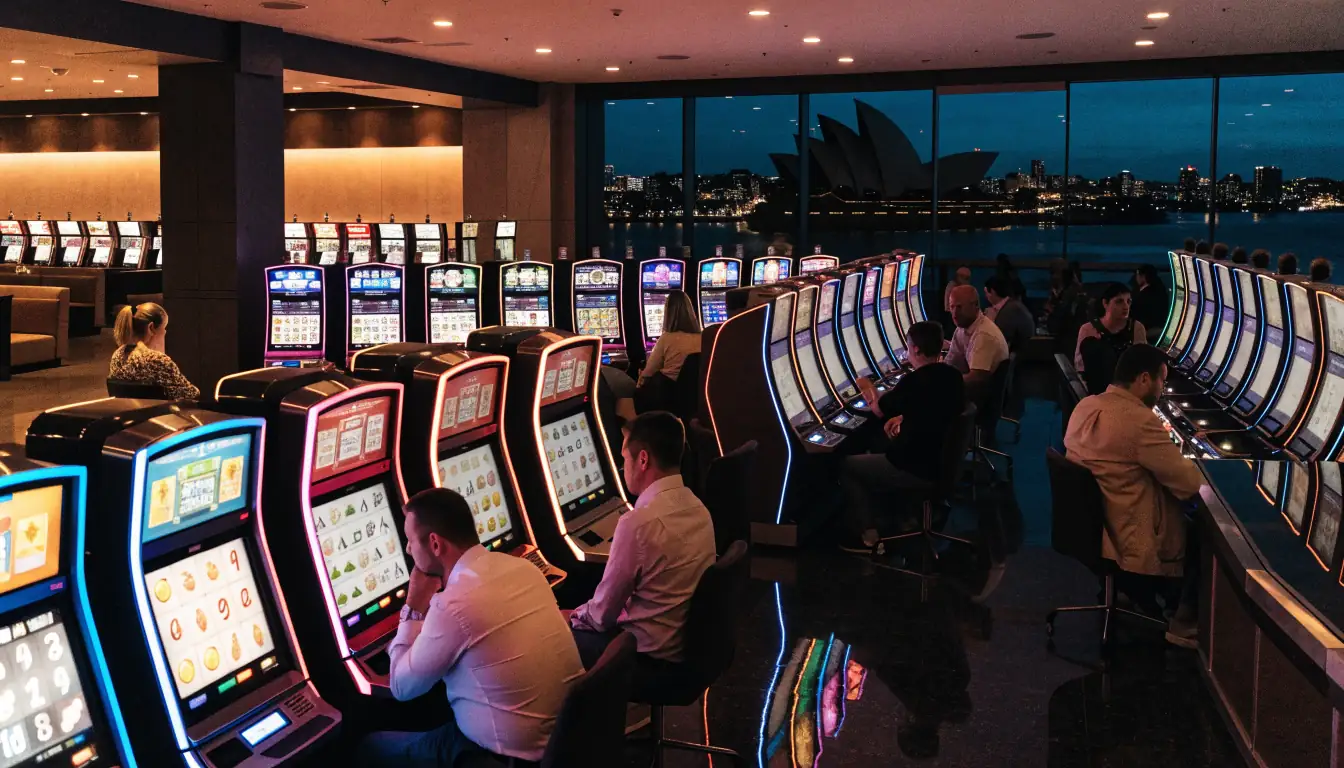
What is not in dispute is that pokies are woven into everyday hospitality venues across the country, and NSW is no exception. Machines are found in local pubs, suburban and regional clubs, and the state’s licensed casinos, forming a distribution network that reaches into small towns as well as metropolitan centres. This breadth of placement — rather than concentration in a handful of large casino floors — is part of what makes the NSW pokies footprint distinctive. A visitor asking where pokies are available in the state is really asking about thousands of individual venues rather than a small number of flagship properties.
National turnover (FY 2020‑2021) Almost AUD 150 billion
Player loss (FY 2020‑2021) About AUD 12 billion
Per‑capita loss AUD 608
2023 turnover estimate AUD 191.2 billion (complyadvantage.com)
More recent turnover data gives a partial sense of how this activity has continued to grow in dollar terms. According to figures reported by complyadvantage.com, pokies generated AUD 191.2 billion in gambling turnover in 2023. This is a single-source figure describing a national total for a specific year, and it should be read as a reported data point rather than as an official or audited benchmark for the industry as a whole — the source and year matter here, because turnover figures of this kind can vary considerably depending on what is counted and over what period. Taken alongside the FY 2020–2021 turnover figure of almost AUD 150 billion, it suggests an industry whose scale has not diminished in the years since that earlier measurement, though the two figures come from different sources and different time frames and are not directly comparable as a growth rate.
Why the scale matters for anyone looking at NSW pokies
The reason this national context matters for a discussion of pokies in New South Wales specifically is that NSW’s regulatory settings, venue density and public debate over gaming machines cannot be separated from the fact that the state operates within — and contributes heavily to — one of the largest gaming machine markets in the world by several measures, even accounting for the disagreement over the exact global share. A market of this size generates correspondingly large regulatory, economic and social questions, and the sections that follow in this discussion of NSW pokies address some of those questions in more specific terms: how venue operating hours and the shift to cashless systems are changing the compliance landscape, how online pokies are treated differently from machines in licensed venues, and what payout data reveals about player experience. None of those more granular questions can be understood in isolation from the basic scale established here — a state where gaming machines are common in the hospitality sector, where turnover is measured in the tens of billions of dollars annually at a national level, and where per-capita losses run into the hundreds of dollars a year.
Licensed hotels and pubs across Sydney and regional NSW, offering pokies alongside food and drink.
Registered community and sporting clubs, a major source of pokies revenue supporting broader services.
State‑licensed casino complexes with a distinct regulatory regime, hosting pokies together with table games.
It is also worth being clear about what this scale does not tell us. Aggregate turnover and loss figures describe the market as a whole; they do not describe the experience of an individual player at an individual venue, and they do not indicate what proportion of NSW’s population accounts for the bulk of the losses recorded nationally. The per-capita loss figure of AUD 608 for FY 2020–2021, for instance, is a population-wide average that includes people who never play pokies at all, which means it understates the losses experienced by those who do play regularly and overstates the exposure of the population as a whole. Readers should treat these national aggregate figures as a way of understanding the size of the industry rather than as a guide to what any particular person is likely to win or lose at a particular venue.
Venue types across the state
Pokies in New South Wales are hosted across three broad categories of venue, each with a different character:
- Pubs — hotels and licensed pubs across metropolitan Sydney and regional NSW commonly operate gaming machines as one part of a broader hospitality offering that includes food, drink and entertainment.
- Clubs — registered clubs, historically linked to sporting, social, returned-services and community organisations, represent one of the largest single categories of pokies venues in the state, reflecting a club culture with deep roots in NSW’s licensing history.
- Casinos — licensed casino venues in the state offer gaming machines alongside table games and other casino-style products, operating under a distinct regulatory regime from pubs and clubs.
This three-part structure is part of why pokies are so widely accessible in NSW compared to jurisdictions where gaming machines are confined to casino floors alone. A person in a regional NSW town is statistically likely to have access to a local club or pub offering pokies without needing to travel to a dedicated casino, and this distribution pattern is a defining feature of the state’s gambling landscape rather than an incidental detail.
Turnover versus loss: reading the numbers correctly
Given how often turnover and loss figures are cited together — and sometimes conflated — in discussions of pokies, it is worth setting out plainly how each should be read.
| Measure | What it represents | FY 2020–2021 national figure |
|---|---|---|
| Turnover | Total value of all bets placed on electronic gaming machines, including money re-wagered from winnings within the same session | Almost AUD 150 billion |
| Player loss | Net amount players were out of pocket after wins and losses were netted off | About AUD 12 billion |
| Per-capita loss | Player loss divided across the whole population, not just players | AUD 608 |
The gap between turnover and loss is not a discrepancy or an error — it reflects the basic mechanics of how gaming machines pay out. Money wagered on a machine is typically returned to players as winnings at a rate that keeps much of it in circulation within a session, meaning a comparatively modest net loss can sit underneath a very large gross turnover figure. This is a standard feature of how electronic gaming machines are measured statistically, and it explains why headline turnover numbers in the hundreds of billions of dollars coexist with loss figures an order of magnitude smaller.
None of the figures above are specific to New South Wales alone; they are national totals for the 2020–2021 financial year. State-by-state breakdowns of turnover and loss are not part of the verified data available here, and no NSW-specific dollar figure for turnover or loss should be inferred from the national numbers. What can be said with confidence is that NSW, given the density of its club and pub network and its position as one of Australia’s most populous states, represents a substantial share of that national activity — without a precise state-level percentage being available to quantify exactly how large that share is.
Online Pokies Illegal
Offering real‑money online pokies to Australian residents breaches the Interactive Gambling Act 2001 and can lead to criminal penalties.
The economic footprint of pokies in the hospitality sector
Pokies are not a standalone product in NSW; they are embedded in a hospitality and community-club business model that has operated for decades. Registered clubs across the state have historically relied on gaming machine revenue to subsidise other services — sporting facilities, subsidised meals, entertainment programming and community grants — a structure that makes pokies revenue relevant well beyond the individual player sitting at a machine. This is a structural feature of the NSW licensed club sector rather than a detail specific to any single venue, and it is part of why gaming machine policy in the state has historically attracted attention from community groups, sporting bodies and local councils as well as from gambling regulators.
At the same time, the scale of national turnover and loss figures discussed above makes clear that this is an industry whose economic footprint reaches well beyond the hospitality sector itself. An activity generating close to AUD 150 billion in turnover nationally in a single financial year, with a reported AUD 191.2 billion turnover figure for 2023 according to complyadvantage.com, represents an economic factor of some significance in the broader Australian gambling and hospitality economy, of which NSW forms a large part given its population and venue density.
What this section does not cover
This overview has deliberately stayed at the level of scale and market structure — how big the pokies sector is nationally, how NSW fits within that picture, and what the turnover and loss figures actually measure. It has not addressed:
- The specific rules governing venue operating hours in NSW, including the extent to which pokies are available around the clock, or the shift toward cashless and account-based gaming systems — these are addressed in the discussion of 24-hour pokies and the cashless transition that follows.
- The separate and legally distinct question of online pokies, including how Crown and other operators are affected by Commonwealth restrictions on real-money online gambling — this is treated on its own terms in a later section, because the legal framework for online gaming differs fundamentally from the framework governing machines in licensed venues.
- What payout percentage data suggests about the return players can expect from NSW pokies — this quantitative question is addressed separately, since payout data is a distinct category of information from the turnover and loss figures discussed here.
Keeping these threads separate matters because conflating them tends to produce a misleading picture. The scale figures set out above describe an industry-wide pattern of wagering and loss; they say nothing about opening hours, nothing about the legality of online play, and nothing about the odds embedded in any individual machine. Each of those questions has its own regulatory and technical answer, addressed in turn elsewhere in this discussion of pokies in New South Wales.
Summary of the scope
Taken together, the figures available for electronic gaming machines in Australia describe an industry of substantial size operating across every state and territory, with New South Wales positioned as a major contributor by virtue of its club and pub density and population size. National turnover approaching AUD 150 billion in FY 2020–2021, player losses of about AUD 12 billion in the same year, and per-capita losses of AUD 608 all describe a market whose aggregate scale is large by any measure, even before accounting for the disputed figures on Australia’s share of the world’s poker machines — 3% by one measure, about 18% by another, a gap that reflects genuine disagreement between sources rather than a rounding issue. A more recent, single-source figure placing 2023 pokies turnover at AUD 191.2 billion, as reported by complyadvantage.com, suggests this scale has persisted rather than diminished, though it should be read as a reported figure from one source rather than an officially confirmed industry benchmark. Pokies remain a routine and widespread feature of pubs, clubs and casinos across NSW, and understanding that basic scope is the necessary starting point before turning to the more specific questions of operating hours, cashless systems, online restrictions and payout data that follow.
Main Conclusions
- NSW hosts a large share of Australia’s pokies market across pubs, clubs and casinos.
- Turnover remains in the hundreds of billions of dollars, with player losses in the low‑single‑digit billions.
- Cashless transition is recommended but not yet mandatory; operators must meet AML obligations based on machine count.
- Online pokies remain illegal for Australian players regardless of land‑based licences.
24‑Hour Pokies in NSW: Cashless Transition and Regulatory Landscape
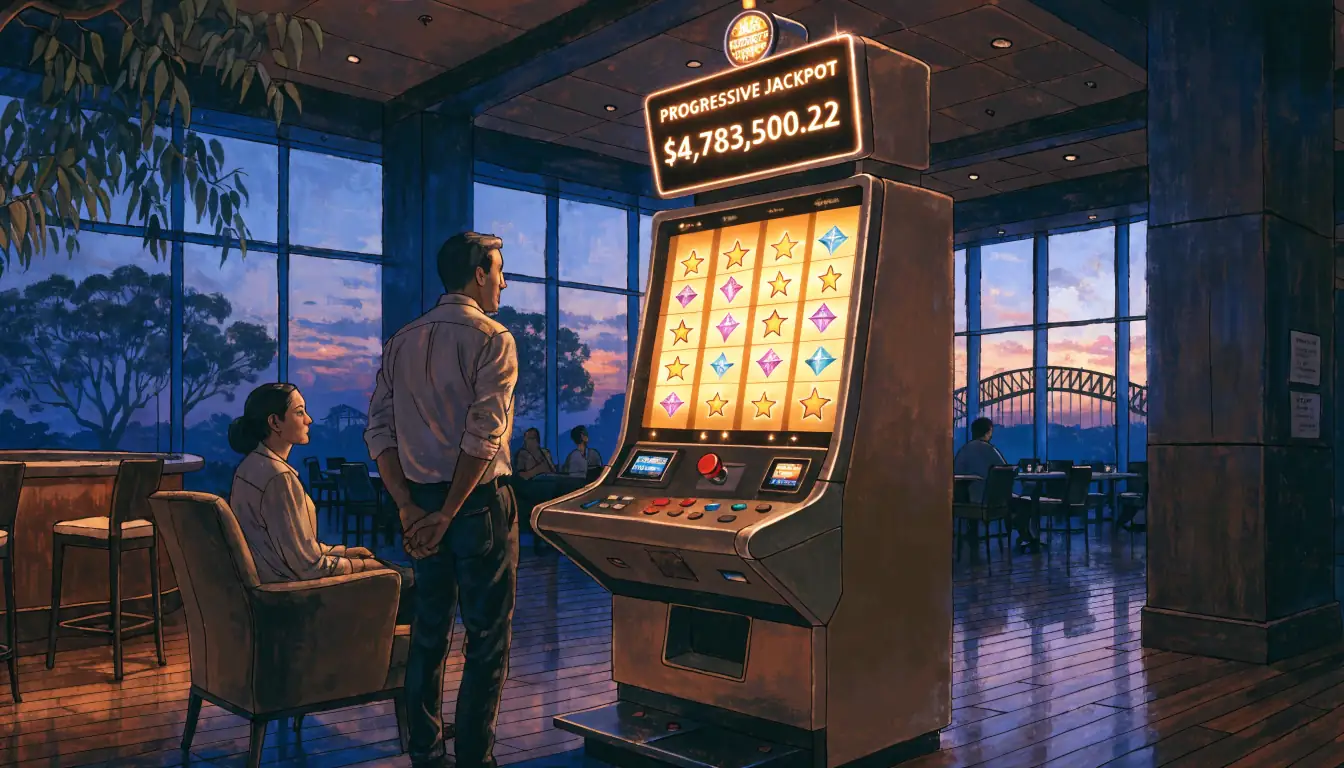
Pubs, clubs and hotels across NSW commonly run pokies around the clock, and the extended availability is one of the features that distinguishes the state’s venues from more restricted jurisdictions elsewhere in Australia. This continuous access, however, sits inside a regulatory framework that is shifting in a specific direction: away from cash and toward account-based, traceable play.
Why cashless is on the table
The 2022 NSW Islington Report recommended making all NSW pokies cashless by the end of 2028. This is the recommendation of a single review rather than a law already in force, and the distinction matters for anyone trying to understand what "cashless pokies" actually means in NSW today. A recommendation sets a policy direction; it does not, by itself, change what happens on a gaming floor. Venues currently operate under a mixed landscape where cash-based machines remain common while cashless, account-based systems are progressively introduced.
The push toward cashless systems is not framed primarily as a convenience upgrade. According to facctum.com, adoption of cashless, account-based pokies improves traceability and reduces anonymity — a claim tied to anti-money-laundering concerns rather than player experience. Transparent, account-based pokies provide full traceability of deposits, gameplay, and withdrawals, which is precisely the feature that cash-fed machines lack. A cash note inserted into a machine, played through with minimal wagering, and cashed out again leaves little trace of who handled it or why. An account tied to identification, by contrast, creates a record that regulators and compliance teams can review.
What this means for round-the-clock play
Twenty-four-hour access does not exempt a venue from the compliance regime attached to its machines. The obligations that apply to an operator depend on the number of pokies on site, not on the hours those machines are switched on:
- Operators with up to 15 pokies must register with AUSTRAC, retain identification records for patrons where required, and submit suspicious matter reports when transactions raise concern.
- Operators with more than 15 pokies carry a heavier load: they must appoint a compliance officer, conduct risk assessments specific to their venue, implement AML/CFT programs, perform customer due diligence, and report cash transactions above AUD 10,000.
A venue running high-limit or high-turnover machines through the night is, in practice, more likely to fall into the second category simply because of scale. The size threshold, not the opening hours, determines the depth of the compliance program a club or hotel must maintain.
Cash versus account-based machines in the same room
It is common, at present, to find cash-accepting and account-based pokies operating side by side in the same NSW venue. This matters for anyone comparing machines on the floor: a high-limit cash machine and a cashless equivalent may look identical from the front, but they sit on different sides of the traceability line described above. Regulators recommend tighter customer due diligence, transaction monitoring, and the adoption of cashless gaming systems as complementary measures rather than substitutes for one another — meaning the presence of a cashless option at a venue does not remove the compliance obligations attached to the cash machines still running alongside it.
For a player, the practical difference shows up mainly at the point of cashing out. An account-based machine ties deposits, play and withdrawals to a single identifiable record. A cash machine does not, which is exactly why the compliance load on operators — identification checks, suspicious matter reports, reporting of large cash transactions — is concentrated around cash handling rather than around account-based play.
Reading "24-hour" and "cashless" together
The two threads — extended trading hours and the cashless transition — are related but not identical. Round-the-clock availability is a feature of venue licensing and trading arrangements; the cashless shift is a compliance and anti-money-laundering measure recommended at the state level and still being phased in. A venue can offer pokies at any hour without having completed a transition to account-based systems, and conversely a venue can run account-based machines without necessarily extending its hours. Anyone assessing a specific club or hotel in NSW is, in effect, looking at two separate variables: how long the doors stay open, and how much of the floor has moved to traceable, account-based play.
What can be said with confidence is the direction of travel set by regulators: cashless systems are recommended, and the compliance burden on operators scales with the number of machines they run rather than with the hours those machines operate. Whether a given venue has fully adopted cashless play by any particular date is not something covered by a uniform, published deadline — the 2028 target comes from one report’s recommendation, not from a confirmed rule applying to every venue in the state.
Compliance obligations at a glance
| Machine count | Registration | Compliance officer | Risk assessment | Large cash transaction reporting |
|---|---|---|---|---|
| Up to 15 pokies | AUSTRAC registration, ID records, suspicious matter reports | Not required | Not specified | Not specified |
| More than 15 pokies | Full AML/CFT program | Required | Required | Cash transactions over AUD 10,000 reported |
This table reflects obligations tied to venue size, not to trading hours — a 24-hour venue with a small number of machines sits in the lighter compliance tier, while a large club running dozens of pokies through the night carries the fuller set of obligations regardless of how continuously its floor operates.
Online Pokies and Crown Casinos in NSW: Legal Constraints
Searches connecting Crown or other NSW casino brands to online pokies reflect a demand that Australian law does not accommodate. The Interactive Gambling Act 2001 makes it an offence for online operators to offer real-money gambling to Australian residents. This provision applies regardless of whether the operator holds a land-based casino licence in NSW or elsewhere. A brand’s physical presence in Sydney or another NSW venue does not extend to a domestic right to run online pokies for real money.
This distinction matters because land-based pokies and online pokies sit under entirely different regimes. Venues licensed to operate electronic gaming machines on their premises are subject to state-based oversight, cashless transition requirements, and AML/CFT obligations already covered elsewhere. None of that regulatory apparatus creates a parallel pathway for the same games to be offered online to NSW residents. No domestic licence exists that would permit it, and no NSW casino operator — including Crown — is authorised to run real-money online pokies for the Australian market.
Searches for “no deposit bonus” offers tied to online pokies in NSW point toward products that fall outside what Australian legislation permits operators to provide to residents. Any online casino-style offer targeting Australian players operates outside the domestic legal framework described here, irrespective of how it is marketed or which jurisdiction issued the operator’s licence.
One point favours players in the segments of gambling that are legally available: winnings are not taxed in Australia. This applies across licensed forms of gambling and is unaffected by the restrictions on online casino products described above. It does not, however, alter the legal status of online pokies — the tax treatment of winnings and the legality of the product offering are separate questions, and the second remains restrictive regardless of the first.
NSW Pokies Payout Percentages: What the Numbers Reveal
Payout percentages for individual pokies in NSW are not published in a way that lets any machine or venue be compared directly. What does exist is aggregate financial data, which describes losses rather than returns, and even that comes with a caveat: figures from different sources describe different years and different scopes, so they should be read as separate data points rather than a single trend line.
In FY 2020‑2021, per‑capita losses from electronic gaming machines across Australia stood at AUD 608. Separately, according to complyadvantage.com, pokies generated AUD 191.2 billion in gambling turnover in 2023 — a figure describing total money wagered, not money retained by operators, and not directly comparable to the per‑capita loss figure above.
Neither number translates into a payout percentage for a specific pokie or venue in NSW. No public register breaks returns down to that level, so claims about typical payout rates for individual machines cannot be verified from available data.
What law governs online gambling in Australia?
The Interactive Gambling Act (2001) makes it an offence for online operators to offer real-money gambling to Australian residents.
What Controls Help Prevent Pokies Money Laundering?
Operators with more than 15 pokies must appoint a compliance officer, implement AML/CFT programs, perform customer due diligence, and report cash transactions over AUD 10,000. Adoption of cashless, account-based pokies is recommended to improve traceability, while AUSTRAC’s 2024 guide helps firms recognize red flags such as large cash insertions followed by minimal play and immediate cash-out.
Are crypto casinos legal in Australia in 2026?
Under the Interactive Gambling Act (2001), it is an offence for online operators to offer real-money gambling to Australian residents, which extends to crypto-based platforms operating domestically.
Published by the Pokies Pro team.