Online Pokies Australia Real Money No Deposit: What the Law
 Available in US
Free Pokies in Australia – How They Work, Regulations and Industry Impact
What "free pokies" actually means under Australian law
The term "online pokies Australia real money no deposit" circulates widely in searches, but the phrase itself sits awkwardly against the legal reality. The Interactive Gambling Act 2001 makes it an offence for online operators to offer real‑money gambling to Australian residents. This is a Commonwealth law, and it applies to the operator, not the player — it is not illegal for an individual in Australia to access an offshore-licensed online casino, but it is illegal for any operator, domestic or foreign, to offer such real-money casino games to someone residing in Australia. Online casino-style games, including slots (pokies), poker, blackjack, and roulette, fall squarely under this prohibition. There is no licensing pathway that permits a real-money online pokies operator to legally serve Australian residents, and no such licence exists to check, display, or verify.
This matters because "free pokies" and "real money pokies" are not two tiers of the same legal product in Australia — they are two different categories entirely. Free-play or demo pokies, where no deposit is made and no cash is staked, do not constitute gambling in the regulatory sense and are not covered by the same prohibition. Real-money online pokies, by contrast, cannot be lawfully offered to Australian residents by any operator, regardless of what jurisdiction issued that operator’s licence. A page promising "real money no deposit" pokies for Australian players is therefore describing something that does not exist as a lawful domestic offering. Where such wording appears, it typically refers to offshore platforms operating outside the reach of Australian regulation — an arrangement the law does not endorse and that carries no consumer protection guarantees enforceable in Australia.
Before claiming any real money pokies offer for 2026, it helps to check how each site’s licensing, bonus terms, and deposit requirements actually stack up.
License: Curacao OGL/2024/1335/0780 · Bonus: up to A$1,000 + 150 free spins, wager-free · Min. deposit: EUR 20 Licensed under Curacao OGL, this operator offers a wager-free welcome package combining a cash bonus with free spins, paired with a modest minimum deposit requirement.
License: Curacao Gaming Control Board OGL/2023/176/0095 (Hollycorn N.V.) · Bonus: up to A$1,500 + 200 free spins across 3 deposits Regulated by the Curacao Gaming Control Board under Hollycorn N.V., it spreads its welcome bonus across three deposits, giving players a staged package of cash and free spins.
Bonus: 240% up to A$4,100 + 300 free spins Notable for a high-percentage welcome bonus that combines a large cash match with a generous batch of free spins.
License: Curacao Gaming Control Board · Bonus: up to A$5,000 + 400 free spins Licensed by the Curacao Gaming Control Board, it stands out for a sizeable welcome bonus paired with a substantial number of free spins.
License: Curacao · Bonus: up to A$10,000 multi-stage + 500 free spins · Min. deposit: A$20 (POLi) Curacao-licensed with a multi-stage welcome bonus reaching a high total value plus free spins, and a low minimum deposit accessible via POLi.
License: Curacao eGaming (Dama N.V.) · Bonus: up to A$10,000 + 180 free spins, 40x wagering Operated by Dama N.V. under a Curacao eGaming license, it offers a large welcome bonus with free spins, though wagering requirements apply.
License: Curacao · Bonus: 100% up to A$500 + 200 free spins, 10x wagering · Payout speed: crypto 30-60 minutes, fiat 1-5 days · Min. deposit: A$10 Curacao-licensed with a straightforward welcome bonus and free spins carrying relatively low wagering requirements, plus fast crypto payouts and an accessible minimum deposit.
License: Curacao · Bonus: up to A$2,000 Licensed in Curacao, this operator is defined mainly by its straightforward cash welcome bonus.
License: Curacao Gaming Control Board OGL/2023/176/0095 (Hollycorn N.V.) · Bonus: up to A$11,000 + 300 free spins (code NEO100) Backed by Hollycorn N.V. under a Curacao Gaming Control Board license, it offers one of the larger welcome bonuses on this list along with free spins unlocked via a bonus code.
License: Tobique Gaming Commission · Bonus: up to A$8,000 + 400 free spins across 4 deposits · Payout speed: crypto ~10-15 minutes, fiat 1-5 days · Min. deposit: A$30 Licensed by the Tobique Gaming Commission, it provides a substantial multi-deposit welcome bonus with free spins, fast crypto withdrawal times, and a clear minimum deposit threshold.
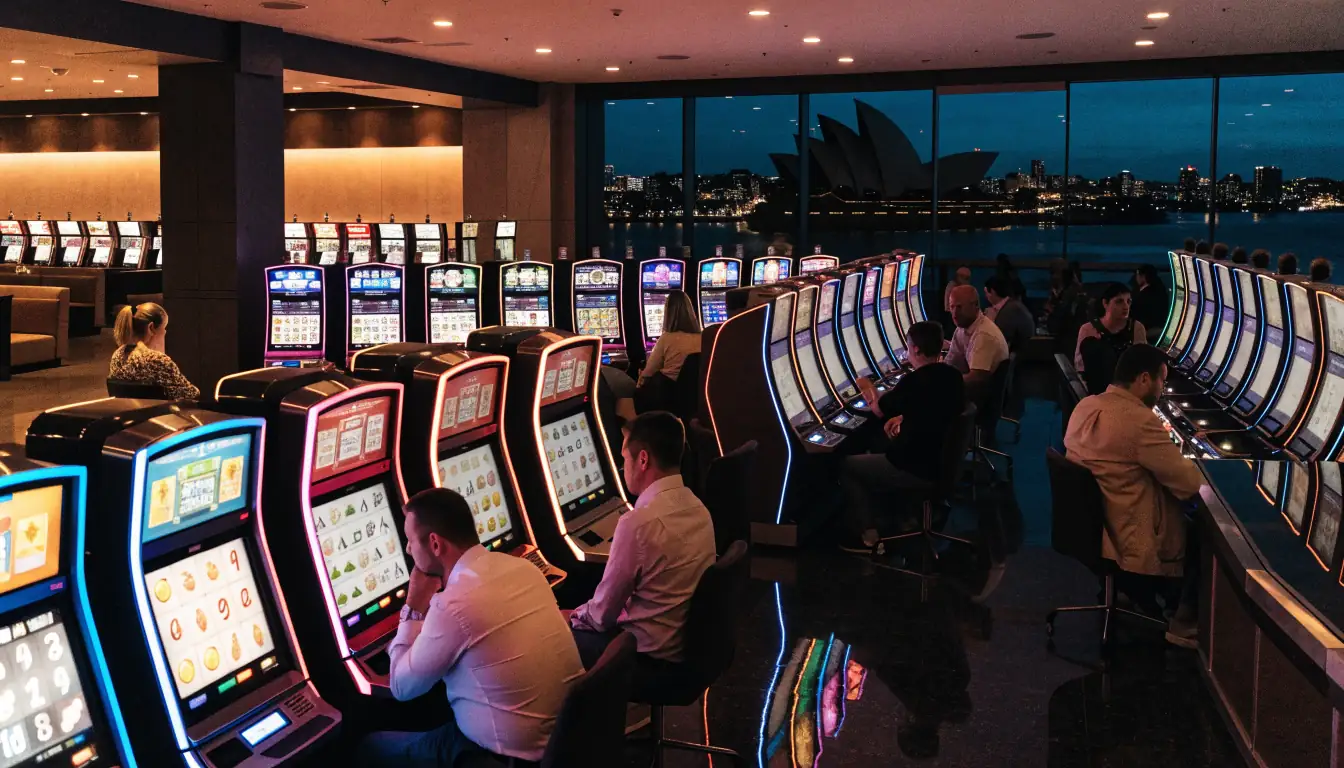
Electronic gaming machines themselves are a different matter. These are physical or terminal-based machines operated in licensed venues — pubs, clubs, and casinos — under state and territory law, and they are legal and commonplace. Electronic gaming machines (EGMs) are operated in all Australian states, the Australian Capital Territory, and the Northern Territory. The confusion between land-based EGMs, which are heavily regulated and legally available, and online real-money pokies, which are not, is one of the more persistent sources of misunderstanding in this space.
The scale of the land-based pokies industry
The physical pokies sector in Australia is large by any measure. In the financial year 2020–2021, Australians placed bets worth almost AUD 150 billion on electronic gaming machines. Of that turnover, the total player loss for the same period was about AUD 12 billion — turnover and loss being very different figures, since turnover includes money that is wagered, won back, and wagered again multiple times within a single session. Per-capita losses from electronic gaming machines in FY 2020–2021 reached AUD 608, a figure calculated across the adult population rather than only among those who gamble.
Separately, one source — complyadvantage.com — reports that pokies generated AUD 191.2 billion in gambling turnover in 2023. This figure is not presented here as an established market benchmark; it comes from a single source describing a different year and a possibly different scope of measurement than the FY 2020–2021 figures above, and the two should not be treated as directly comparable or averaged together.
Legal status of online real‑money pokies Prohibited under the Interactive Gambling Act 2001
Legal status of free‑play pokies Allowed as demo games with no cash payout
AML obligations for venues Required for operators with more than 15 machines
Cashless pokies Proposed by NSW Islington Report, not yet law
On Australia’s share of the world’s poker machine stock, the sources disagree in a way worth stating plainly rather than resolving by choice. One figure holds that Australia accounts for 3% of the world’s pub and club poker machines; another puts the figure at about 18% of the world’s poker machines. These are substantially different claims, and nothing in the available material explains the gap — it may reflect different definitions of "poker machines" (pub and club machines only, versus all gaming machines including casinos), different reference years, or simply inconsistent sourcing. Either figure could be cited elsewhere; neither should be treated here as settled.
Taxation of gambling operators in Australia varies by state and by type of gambling service, meaning there is no single national tax rate applied uniformly to pokies revenue — the arrangement differs by jurisdiction and by the category of gambling product involved. On the player side, gamblers’ winnings in Australia are not taxed, a position that holds regardless of which state the win occurred in or how much was won.
Why the free-play / no-deposit framing exists at all
Given that real-money online pokies cannot lawfully be offered to Australian residents, the free-play or demo version of a pokies title serves a specific function: it lets a game be shown, tested, and marketed without crossing into the offence created by the Interactive Gambling Act 2001. A free-play pokie uses virtual credits with no monetary value, requires no deposit, and returns no withdrawable winnings. This is why "no deposit" and "free" appear together so often in relation to pokies aimed at the Australian market — the no-deposit format is not a promotional gesture layered on top of real-money play, but the only form in which a pokies title can be presented online without breaching Commonwealth law.
Illegal online real‑money pokies
Offering or playing real‑money online pokies to Australian residents breaches the Interactive Gambling Act 2001 and can lead to criminal prosecution.
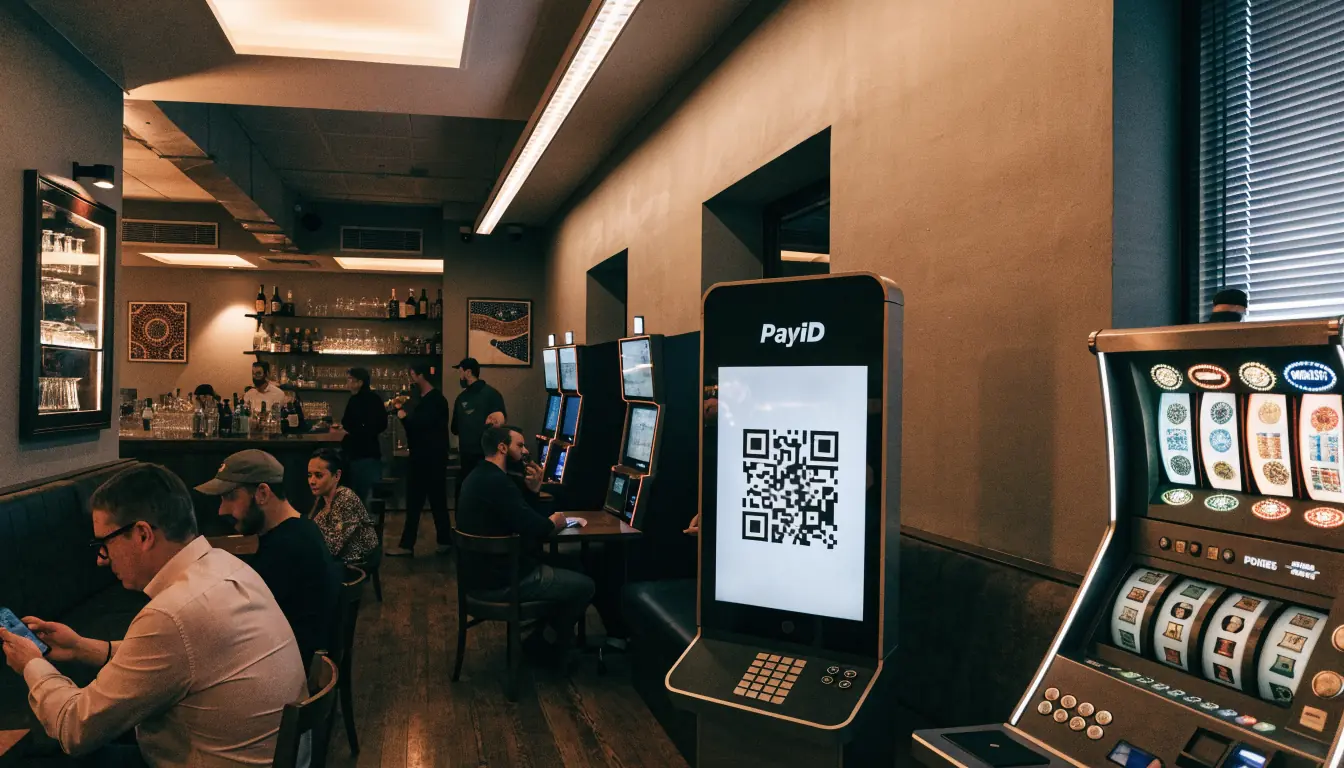
It follows that any offer describing itself as "real money no deposit pokies" for Australian players occupies a legally uncertain position at best. Genuine no-deposit free play, by definition, does not pay real money. A product that claims to combine "no deposit" with "real money" for an Australian resident is either not being offered by a lawfully compliant operator, or is misdescribing what it actually provides. Readers searching for instant PayID pokies or similar payment-linked real-money offers should treat the payment method itself as irrelevant to the underlying legal question: no payment rail changes the fact that an online operator offering real-money pokies to someone in Australia is doing something the Interactive Gambling Act 2001 was written to prevent.
Regulatory structure governing pokies venues
While online real-money pokies fall outside any legitimate Australian licensing framework, land-based electronic gaming machines are subject to a detailed compliance regime, largely administered through anti-money-laundering and counter-terrorism financing (AML/CFT) obligations rather than gambling-specific licensing alone.
AUSTRAC, the federal regulator responsible for financial crime oversight, issued a guide in 2024 to help firms recognise money-laundering red flags connected to pokies. The obligations imposed on venues scale with the number of machines operated:
- Operators with up to 15 pokies must register with AUSTRAC, keep identification records on relevant transactions, and submit suspicious matter reports when warranted.
- Operators with more than 15 pokies face a heavier set of obligations: appointing a compliance officer, conducting risk assessments, implementing AML/CFT programs, performing customer due diligence, and reporting cash transactions over AUD 10,000.
Non-compliance carries a graduated set of consequences. Operators found not to be meeting these obligations may receive remedial directions, infringement notices, and civil fines, in addition to reputational damage that can affect their standing with regulators and the public. This structure treats pokies venues less like conventional retail gambling outlets and more like cash-intensive financial access points that require monitoring comparable to other parts of the financial system.
State-level regulators add a further layer. In New South Wales, an amendment to the Casino Control Act 1992 allows casino operators to be fined up to AUD 100 million for compliance failures — a figure that signals how seriously state authorities treat lapses in this area, particularly following scrutiny of casino operations in NSW in recent years. Other state and territory bodies, including the ACT Gambling and Racing Commission and the Office of Liquor and Gaming Regulation, hold parallel responsibilities for licensing and supervising gaming machines within their own jurisdictions, alongside the Australian Communications and Media Authority (ACMA), which handles compliance under the Interactive Gambling Act 2001 for online offerings.
Cash, traceability, and money laundering risk
A recurring theme in regulatory guidance on pokies is the link between cash handling and financial crime risk. Pokies are widely used in Australian pubs, clubs, and casinos, and the high volume of cash transactions combined with the limited traceability of individual sessions is what makes them attractive as a laundering channel — not because the machines themselves are unusual, but because cash-in, cash-out mechanics create an opportunity to disguise the origin of funds.
In FY 2020‑2021 Australians wagered almost AUD 150 billion on electronic gaming machines, with player losses of about AUD 12 billion.
The mechanics described by regulators and researchers follow a few recognisable patterns:
- Minimal-play cash conversion. Criminals insert large sums of cash into EGMs, engage in minimal gambling activity, and then cash out — creating a paper or ticket record that makes the money appear to be legitimate winnings rather than an unexplained cash sum.
- Ticket purchasing. Offenders purchase winning tickets from other players, handing over dirty cash in exchange for a ticket that can be redeemed as clean, traceable funds — effectively buying a legitimate-looking payout history from someone else.
- Structuring across venues. This involves spreading smaller cash deposits across multiple venues specifically to stay under AML reporting thresholds that would otherwise trigger scrutiny at a single location.
- Recruitment of money mules. According to complyadvantage.com, money mules are recruited to launder funds through pokies — individuals who insert or redeem cash on behalf of others, distancing the actual source of the funds from the transaction record.
AUSTRAC’s 2024 guidance sets out a list of red-flag indicators venues and compliance staff are expected to watch for. These include unusually high cash access relative to a customer’s apparent means, large deposits, cash transfers, casino disbursement checks, and certain occupations considered higher-risk from a financial-crime perspective. More specific behavioural patterns are also flagged: large or repeated cash insertions followed by minimal play and an immediate cash-out; frequent small redemptions carried out across different venues within a short period; and customers who refuse identification or who are found using multiple player cards.
Toward cashless and account-based systems
Much of the regulatory direction in this area points toward reducing the anonymity that cash-based pokies allow. The 2022 NSW Islington Report — a single inquiry report, not a nationally binding standard — recommended making all NSW pokies cashless by the end of 2028. This recommendation has not been presented here as an already-implemented rule; it is a policy proposal from one report, and its eventual adoption, timeline, or scope may change as the legislative process unfolds.
The rationale behind cashless proposals rests on a straightforward technical point: transparent, account-based pokies provide full traceability of deposits, gameplay, and withdrawals, in a way that cash-in, cash-out machines cannot. According to facctum.com, adoption of cashless, account-based pokies improves traceability and reduces the anonymity that makes structuring and ticket-purchasing schemes possible in the first place. This is presented by that source as an argument in favour of the shift, not as a description of a change that has already occurred market-wide.
Cashless pokies are a proposal
The recommendation to make all NSW pokies cashless by the end of 2028 is still a policy proposal and has not been implemented.
Consistent with this direction, regulators broadly recommend tighter customer due diligence, more active transaction monitoring, and continued movement toward cashless gaming systems as the primary tools for reducing financial-crime exposure in the pokies sector. Providers such as FacctGuard, FacctShield, and FacctView are among those offering compliance and monitoring technology built around these objectives, though the substance of the shift lies in the regulatory expectation itself — visibility into deposits, play, and withdrawals — rather than in any single vendor’s product.
What this means for anyone searching for real-money pokies online
None of the above changes the basic legal position for anyone in Australia looking for online pokies that pay real money without a deposit. The Interactive Gambling Act 2001 prohibits operators — wherever they are based — from offering real-money casino-style games, pokies included, to Australian residents. No state or federal body issues a licence for this activity, and no public register exists for Australians to check an operator’s standing, because there is no domestic licensing category to be listed under. Land-based electronic gaming machines in licensed pubs, clubs, and casinos remain the legally regulated form of pokies play in Australia, governed by state and territory rules and layered AML/CFT obligations rather than by an online licensing regime.
Free-play, no-deposit pokies — the kind that use virtual credits and return no real winnings — sit outside this prohibition and are the only form in which pokies content can be offered online to an Australian audience without breaching the law. Anyone encountering an offer that blends "real money" with "no deposit" in an Australian context should read that combination as, at minimum, legally ambiguous, and should not assume that any consumer protection, dispute-resolution mechanism, or licensing oversight recognised in Australia stands behind it.

For readers concerned about their own or someone else’s gambling behaviour, BetStop — the National Self-Exclusion Register — and Gambling Help Online provide avenues for support that are independent of any specific operator or platform. The minimum legal gambling age in Australia is 18, and access to any gambling product, free-play or otherwise, should be restricted accordingly; research cited by the Australian Institute of Criminology indicates that almost one in three (30%) 12–17-year-olds in Australia gamble in some form, and 46% of 18-year-olds gamble, underscoring why age-verification and harm-minimisation measures remain a live regulatory concern rather than a formality.
Lightning Link Free Play – No‑Deposit Bonus Overview
Lightning Link is among the pokies titles frequently searched for in a free-play, no-deposit format. What can be stated with certainty concerns the legal boundary around it rather than the terms of any particular offer: the Interactive Gambling Act 2001 makes it an offence for online operators to provide real-money gambling to Australian residents, and this applies regardless of how a promotion is labelled. A demo or "free play" version that involves no wagering and no monetary prize sits outside that prohibition; a real-money offering under the same name does not.
Named terms, wagering conditions, or bonus amounts attached to a Lightning Link no-deposit promotion are not published by any official source and cannot be verified here. Operators offering real-money gambling to Australian residents also fall under state-based taxation arrangements, which differ by jurisdiction and by the type of gambling service provided.
Prepared by the Pokies Pro editorial staff.